
Georgia's HB 581 Floating Homestead Exemption Explained
A floating homestead exemption is a cap on how fast your home's taxable value can grow - and the cap tracks inflation instead of whatever the housing market happens to be doing that year. For homeowners in areas where property values have gone up quite a bit, it's one of the more helpful protections available to keep your annual tax bill from rising out of control.
HB 581 brought this type of cap to Georgia, and it took effect with the 2025 tax year. The legislation came with a few strings attached, though. Local governments were given the option to pass on it altogether, a new local sales tax option got folded into the package, and the deadlines for homeowners moved quickly. Missing the filing window can leave you in a legitimately frustrating position.
One point to address immediately - all the cap does is put a limit on how much your home's assessed value can rise each year. The tax rates that local governments set are a whole separate matter, and those can still move up or down on their own schedule, whatever the cap says.
This is one of the more common mistakes I run into. When that property tax bill arrives, and the number isn't what you were hoping for, the disconnect between your assessed value and your tax rate is usually what's behind it. Your exemption was built to slow down how fast your taxes climb over time. The sooner you have it in place, the less frustrating the whole experience will be when the next bill arrives.
Here's a full overview of Georgia's HB 581 Floating Homestead Exemption.
How the Bill Became a Georgia Law
HB 581 passed in 2024, and with a bill this big, the legislative vote was only half of the job - it directly changed how property taxes are calculated across the entire state, which meant a quick vote in the legislature wasn't going to be enough. A change at that level called for an amendment to Georgia's state constitution. At that point, the matter moved out of the legislature's hands, and Georgia voters had a direct say in whether it would actually become law.
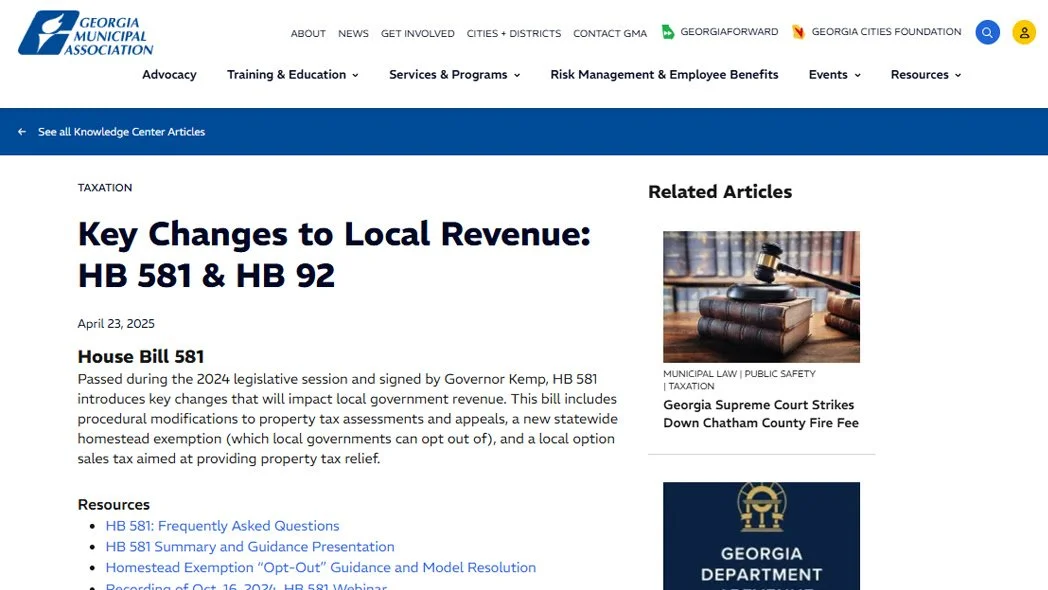
Amendment 1 went to voters back in November 2024, and it passed by a pretty wide margin - roughly 63% of the vote. That voter approval was the final piece that was needed for HB 581 to take effect, which it did as of the 2025 tax year.
The push for this legislation traces back directly to what happened to home values after 2020. Prices went up fast - and in a few markets they went up considerably faster than most homeowners' finances could manage. For many of these homeowners, the issue wasn't that they had bought more house than they could afford - it was that the home they already owned had just gone up in value at a rate that was well out of their hands. A homeowner on a fixed income, say, has no actual way to control what the county assessor decides their property is worth each year. Their tax bill can jump quite a bit from one year to the next regardless of whether their financial situation has changed at all.
The floating homestead exemption was the legislature's direct response to that problem (it ties increases in a home's taxable value to the rate of inflation and puts a cap on how fast a homeowner's tax assessment can grow from one year to the next). It won't freeze anyone's taxes permanently - that's not what it was designed for.
What it does is put a firm limit on how fast those increases can go, and for Georgia homeowners, that's just the protection they were looking for.
The Cap That Limits Your Tax Bill
The measure took effect almost immediately once voters passed it. For most homeowners, whatever their home was assessed at in 2024 became the new starting point - the baseline that everything else gets measured against going forward. From there, any annual increases to your home's taxable value are tied directly to inflation - specifically through the Consumer Price Index, or CPI. At 3% inflation, say, your taxable value can only rise by that same 3% regardless of what the housing market is doing at the time.
A concrete example makes this much easier to follow. Say your home was assessed at $300,000 in 2024. If the CPI comes in at 3% the following year, your new taxable value moves to $309,000 - even if your home's market value climbed to $340,000 or more. That difference between what your home is worth on the open market and what you're being taxed on is where the savings are. The longer you stay in the home, the more that difference builds in your favor.

But a couple of exceptions apply here. Big improvements to the property (a new addition, a garage or a large-scale renovation) can still drive your assessed value up, cap or not. And when a home changes hands, the cap resets for the new owner based on what the property is actually worth at the time of the sale.
Other states have had this protection in place for decades. Florida's Save Our Homes amendment works in a very similar way, and California's Proposition 13 has had a version of this since 1978. From what I've seen, states that adopt this strategy almost never turn back. Homeowners are left with predictable relief, and the terms are laid out plainly enough that you can plan your finances around them.
Why Some School Districts Said No
Not every taxing authority in Georgia signed on to HB 581. Counties, cities and school districts all had the option to pass on the floating homestead exemption - and quite a few school districts went ahead and did just that.
The reasons differed, and some of them were pretty understandable. Some districts had actual worries about what a permanent inflation cap would mean for their long-term budgets - especially in areas where property tax revenue is the main way that schools get their funding. Others already had local exemptions in place and didn't want a statewide policy piled on top of what they'd already worked out. Both points are fair - and the end result still left plenty of homeowners in a pretty frustrating situation.

Frustrating is the right word for it. The cap can still apply to the county and city portions of your tax bill when a school district opts out - just not the school portion. For a fair number of homeowners, the school portion ends up as the biggest chunk of the total bill, and that makes the choice feel especially significant.
The situation around districts that opted out of the exemption has continued to change as we've moved through 2026, and some open questions remain about whether districts that passed on the exemption early on can circle back and sign on at a later date. My best advice here is to go right to the source - call your local tax authority directly and ask where your district stands. The answer might not be the same now as it was when HB 581 first passed, so confirm that your full bill is protected before you count on it.
A Sales Tax That Lowers Your Property Bill
Local governments were handed a new tool (a particular type of sales tax called FLOST, which stands for Floating Local Option Sales Tax), and the whole idea behind it was to take some of the financial weight off of property owners.
The basic concept behind FLOST is pretty easy to follow - the full tax burden doesn't fall on property owners alone. A slice of every sale made at the register helps lower what local governments would have otherwise had to raise through property taxes. Local voters still had to approve it first, and the choice to bring in FLOST also meant the homestead exemption stayed active.

What sets FLOST apart is the number of shoppers who pay into it. Every time a renter, a tourist or a visitor from out of town buys something in a participating county, they're adding to the fund - and not a single one of them qualifies for the homestead exemption. That's a pretty genuine financial benefit for a homeowner in a county that's signed on. Part of what cuts back on their property tax bill is money from shoppers who will never see any of that benefit themselves.
The math works out a little differently for renters. Whether that feels fair or not does come down to your own situation. A homeowner and a long-term renter who live on the same street are probably going to have very different feelings about FLOST.
Who Saves the Most on Their Taxes
Long-term homeowners in fast-growing areas are usually the ones who benefit the most from this type of protection. Fulton County is a prime example since its residential property values climbed by over 40% between 2019 and 2023. That growth goes right onto your tax bill when you don't have a cap in place - and it adds up much faster than you would want it to.
Retirees on fixed incomes have had an especially hard time with this. A home's value can climb steadily for years - but a retirement income just doesn't move along with it. A few hundred extra dollars in annual taxes can put strain on the finances of anyone on a tight monthly budget - and a number like that can change what a person is able to afford from one month to the next.
The floating exemption won't do a whole lot in practice for homeowners in counties where prices have stayed pretty flat. The cap exists to put a ceiling on growth - so the difference it makes is pretty minimal when prices aren't climbing much.
Newer buyers are in a pretty different position than long-term owners. It's helpful to try to know where they stand. The assessed value of a home gets set at or near the going market rate when it's purchased - which is already a higher starting point than where a buyer who purchased the same property a decade ago started.
The exemption does protect you from steep future increases from that point forward. But it won't pull your starting value back down. What it does is slow the pace at which your tax bill grows over time - it won't cut back on what you're already paying. The relief builds slowly instead of all at once - so expectations about that do matter.
File Before the April 1 Deadline
Your application for the floating homestead exemption gets filed through your county tax assessor's office. In most Georgia counties, the deadline is April 1 - a date that you'll want on your calendar well ahead of time.
One of the most common mistakes with HB 581 is when homeowners just assume their existing homestead exemption will automatically roll over to cover the floating exemption. Whether it does or not can depend on your county - in some places it carries over on its own, and in others you'll need to file for it separately. A quick call to your county assessor's office will give you a straight answer in about 2 minutes, and it's well worth making before you're left with less coverage than you expected.

When it's time to apply, bring proof of ownership, a Georgia ID or driver's license with your home address on it and a copy of your deed. Some counties will also want a few extra documents, and the list can be pretty different from place to place. A quick call to your local office first is worth it - no one wants to make that drive twice.
New homeowners are by far the group most likely to miss the April 1 deadline - and it's something I see a lot more than you would guess. The first year in a new home is a lot to manage - you have a hundred tasks competing for your time and attention all at once, and the tax assessor's office tends to slide way down the list. What that costs you is an entire year out of the program - 12 months of savings that are just gone with no way to get them back. Take a few minutes before April gets here to make sure that you're squared away if you bought your home within the last year and haven't filed yet.
Habits That Could Leave You Paying More
Even with the floating homestead exemption working in your favor, one misconception comes up more than almost any other - the idea that a capped assessed value automatically means a lower tax bill. The cap only controls how much your home's taxable value can increase from year to year - it doesn't touch the tax rate itself. If your local government decides to raise the millage rate, your bill can still rise even if your assessed value hasn't moved at all. The taxable value and the millage rate are two separate numbers, and each of them can move on its own.
Renovations matter here as well. As mentioned earlier, any improvement that brings actual value to your property can trigger a reassessment - and when that happens, the new assessed value resets your baseline from that point forward. A big kitchen remodel, or a room addition, is a win - just know that it also tells the assessor's office to take a fresh look at what your property is worth.

One of the costliest habits I see homeowners fall into is letting that annual property assessment letter get buried at the bottom of the pile. That letter has a deadline attached to it, and the appeal window is short. Once it closes, that assessed value is locked in for the rest of the tax year - and at that point there's no way to contest it.
Every time that letter arrives, take a few minutes to actually go through it. Check what your property has been assessed at and look at a few of the recent sales in your area. If something feels off, get the appeal process going before the deadline hits. A little attention each year can mean some actual savings over time.
Moving to Atlanta?
At its core, it's all pretty easy to follow - your home's taxable value can only grow by the rate of inflation each year. That protection does have a couple of conditions, though. Your local government has to be participating in the program, and your paperwork needs to be in by April 1. Those two conditions (your county's participation and the filing deadline) are worth confirming early. A quick call to your county tax office will answer those questions, and it'll give you a much better sense of what you're protected from.
A cap like this is a big deal for homeowners who have spent years watching their property tax bills climb with no real way to fight back, though it won't undo the increases that have already hit them and it's not going to fix everything at once. What it will do is give long-term homeowners something they've never actually had before - a firm ceiling on how fast their bills can move in the wrong direction. That alone is worth quite a bit even if the full benefit takes a little while to add up. At the very least, it gives you something concrete to plan around.
Buying a home in Atlanta involves more than the house itself - the neighborhood that you settle in is every bit as big a factor. Atlanta has a number of areas to choose from, whether you want a quieter suburban street or something closer to the city with more going on. The Justin Landis Group knows this market well and helps you narrow your options down to a place that fits your life. Get in touch with us to get the conversation started.