
How Do Property Tax Exemptions Work on Atlanta Homes?
Fulton County has a few exemptions that can lower your annual property tax bill by thousands of dollars. The catch is you're responsible for filing the applications yourself - nobody at the county office is going to automatically apply these discounts for you, and they definitely won't send out any reminders when the deadlines roll around. Tons of Atlanta residents overpay every year because they either missed a filing deadline or never even found out about which exemptions they were eligible for!
It's not a great feeling when you're talking to neighbors about property taxes and find out that you've been paying hundreds of dollars more each year than you should. Most homeowners don't know this. But you can combine multiple exemptions on the same property. The standard homestead exemption can be stacked with the senior or disability exemptions - they all work together to chip away at your assessed value before the county does the math on what you owe. Miss an application deadline, and you're stuck waiting for another full year to reapply, all as you continue to overpay. A few hundred dollars in yearly exemption savings can be the deciding factor in whether you get to stay in your home or need to sell when you're on a fixed income or already watching every dollar.
Here's how these tax exemptions could help you save on your Atlanta home!
How Property Tax Exemptions Work in Atlanta
Property tax exemptions work to lower the portion of your home's value that the county can tax. Qualifying for one of these exemptions means the county will take that exemption dollar amount and subtract it directly from your property's assessed value before it does anything else. Once that subtraction is done, they'll use that lower number to work out what you actually owe for the year.
With a home assessed at $300,000 and a $10,000 exemption, the county will only tax you on $290,000 of that value. They won't tax the full $300,000. Year after year, this adds up to some savings on what you pay in annual property taxes.

Atlanta homeowners work with Fulton County for their property tax exemption needs. The county office is where you can send in your application, and they take care of every exemption that covers properties within Atlanta's city limits.
Exemptions never get assigned automatically, and I can't stress this enough - it's one of the most common mistakes homeowners make every year. The county can't give you an exemption just because you could be eligible for one, and they won't do it unless you ask first, period. The whole application process means you have to fill out the paperwork yourself, and those forms have to be turned in before the deadline hits. A lot of homeowners don't get the money that they would have saved, all because they never actually submitted their application.
Multiple exemptions work together on the same property, and you should know that each of them lowers your taxable value differently. What you should do is see which exemptions you qualify for and then actually take care of the paperwork to claim them.
What the Homestead Exemption Can Save You
When Atlanta calculates your property taxes, it uses your home's assessed value - what the city determines your property is worth. The homestead exemption is a tax benefit designed to bring down that assessed value before they apply any tax rates to calculate what you owe. To qualify for this exemption, the property needs to be your primary residence (investment properties and vacation homes don't count). Once you're approved, it can remove as much as $75,000 from your assessed value, and it can lower what you pay each year.
This only works for your primary residence - the home where you actually live full-time. Any investment properties you own aren't going to qualify. Vacation homes won't be eligible either. A $300,000 home with the homestead exemption applied only gets taxed on $225,000 of its value. The amount you save from this will depend on your local millage rates. But you're usually looking at hundreds or thousands of dollars every year.

The city doesn't send reminders in the mail. Submit the paperwork by the deadline.
To get this exemption, you'll need to prove that the property is actually your primary residence. You'll need a Georgia driver's license with the property address on it, along with voter registration at that same location. The city also needs to make sure that you own and live in the home as of January 1st for the tax year in question.
Once you've completed the application and received approval, the exemption will renew each year automatically without any extra effort on your part. You won't need to submit new paperwork or reapply unless something changes with either your ownership status or where you live.
Additional Qualifying Homeowners
Atlanta homeowners who are age 65 and older qualify for some extra exemptions that go beyond the standard homestead exemption. These extra breaks stack right on top of whatever basic exemption you already have, and they'll bring your tax bill down even more.

Disability exemptions work the same way. Your city understands that property tax bills add up very fast when you're on a fixed income or have extra costs due to a disability. These exemptions are there to help ease some of that financial pressure.
Veterans with service-connected disabilities are eligible for extra benefits that are on top of the standard exemptions. The state and the county have programs to help lower property taxes for disabled veterans as a way to honor their sacrifice. These combined benefits can result in large savings that add up year after year.
Many elderly homeowners in Atlanta depend on these exemptions just to stay in their homes. The money they save every year can determine whether they stay in the house they've lived in for years or have to sell it and move. These programs are here specifically to help seniors stay in their homes for as long as they want to.
Each one of these extra exemptions works as an addition to your homestead exemption instead of a replacement for it. So you can stack them together and maximize the total amount you save. The application process is going to need a few documents that verify your age or disability status. There's some paperwork that you'll have to take care of on the front end. But once you're approved, you'll see the benefits in the form of a lower property tax bill year after year.
How Much Money You Can Make
Property tax exemptions in Atlanta have qualifications, and they're pretty easy to understand when you know what to look for. Senior homeowners can qualify for the most common type of exemption, and it's available right when you turn 65. That birthday milestone is a great first step. But you'll need to meet a few other criteria as well.
Approval for these programs depends on how much money your household brings in each year. Fulton and DeKalb counties set income limits between $35,000 and $40,000 annually for senior homeowners who want to qualify for most exemptions. To see if you meet this threshold, Georgia looks at the adjusted gross income on your federal tax return - that's the main number they care about. That covers wages and any distributions you take from retirement accounts. The nice part, though, is that Social Security benefits aren't part of that calculation, and some of the veterans' benefits don't count either.
The income cutoffs are frustrating for homeowners who fall just slightly over the limit. A household that earns $40,500 per year might not qualify. But the family next door, who makes $39,800, could get approved with no problem at all. We're talking about a difference of just a few hundred dollars per year in income. But it ends up being worth thousands of dollars in tax savings over time.

Disability exemptions are handled a little differently, and they follow their own standards. Georgia actually uses the Social Security Administration's standards when determining what counts as a disability for tax purposes. To qualify for one of these exemptions, you'll need to show that you're already receiving disability benefits through Social Security, or that you meet the same criteria that the system uses. Just remember that most disability exemptions still have income limits you'll need to stay under.
These thresholds can change quite a bit, and they're never set in stone. State legislators can adjust the income limits whenever they meet for a session, and each county also has some flexibility to adjust its own standards as long as it follows the state's basic guidelines. An exemption you didn't qualify for last year might actually be available to you this time around.
Homeowners can lose their exemption status without even realizing it - usually because the qualifications changed from one year to the next. Other homeowners find themselves suddenly eligible after the income limits increase, and they had no clue that it even happened. The criteria do change quite a bit, so even if you checked on this a year or two ago and didn't qualify at the time, it's worth checking in again on the latest standards to see if anything changed.
How to File for Your Exemption
Each exemption requires different paperwork, and the county will want to see different documents depending on which one you're after. The basic homestead exemption is pretty simple - you just need to prove that you live at the property. A driver's license or utility bill with the correct address will work just fine. Senior citizen exemptions get a bit more involved because of income limits, so you'll need to send in income statements with your application. Disability exemptions need medical documentation, and usually that means a letter from your doctor.
Fulton County actually has an online system now that makes the whole process much easier. You can file for most of your exemptions right through the county website. Create an account, and you can upload all your documents online. The website will talk about each step and tell you what paperwork you need for whichever exemption you're going after.
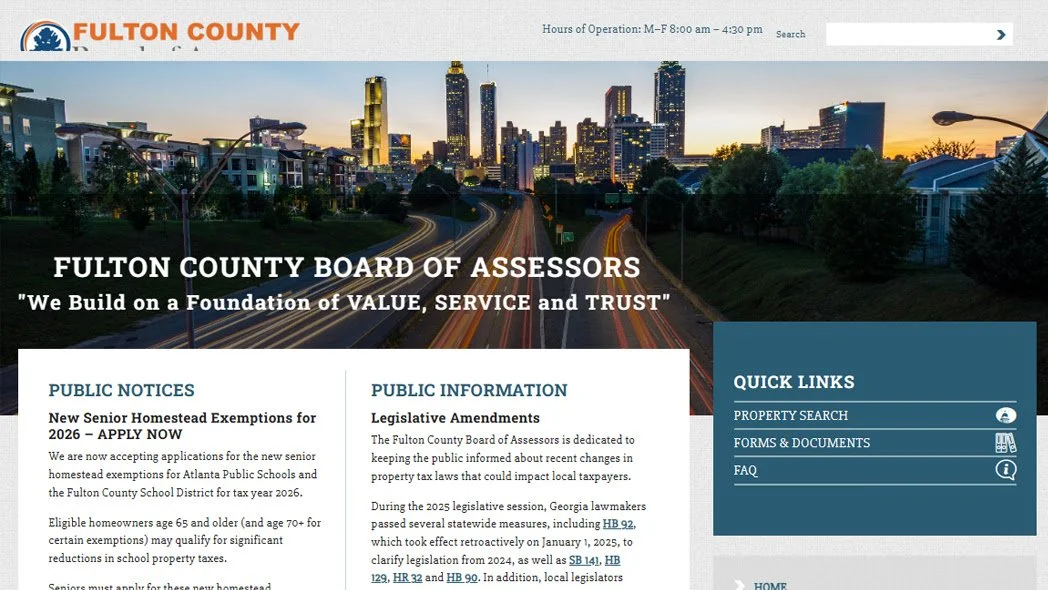
Some exemptions are going to need you to visit the tax assessor's office in person. If your case needs extra verification, or if there's something a little unusual about your situation, you'll probably need to make the trip down there.
Most homeowners wind up waiting until their second year of ownership to file for this. The first year after a move is usually pretty busy. With boxes to unpack and the need to get settled, the April 1st deadline just passes by before there's a chance to handle it, and by the time they find out about these exemptions, April 1st has already come and gone. What ends up happening is that they have to pay the full tax bill for another entire year before they can start to see any exemption benefits.
The upside is that most exemptions renew automatically after you get approved. You'll only need to apply again if your situation changes or if the county asks for updated documents.
Property Tax Mistakes That Cost You Money
Every year, thousands of Atlanta homeowners wind up paying more in property taxes than they should, and usually it happens because they don't know how homestead exemptions actually work if you move. Your exemption doesn't automatically carry over to your new property, and it doesn't matter if you had one at your previous address - each new home requires its own application.
Life changes can also affect your exemption status in some big ways. Marriage is a great example - it can change which exemptions you're actually eligible for. Divorce falls into the same category. Anytime this happens in your life, the county assessor is going to need to know about it so they can make sure that your property records show your current situation.

Plenty of homeowners assume right from the start that they make too much money to qualify for anything worth their time, so they skip the research phase and never look into what the income limits actually are. Income limits for these programs aren't set in stone, though - they adjust every year based on factors like the median income levels and the cost of living in your area. Checking what your county needs takes maybe 5 minutes tops, and there's a decent chance you'll discover that you qualify even if you didn't think you would.
Your personal circumstances can change over time, and when they do, it's always worth taking a second look at what exemptions are out there. Say your disability status has changed or you've recently turned 65 - there may be new exemptions you can qualify for now that you weren't eligible for before.
Add up all these mistakes, and the money lost can pile up fast. A missed homestead exemption alone can cost you anywhere from a few hundred to a few thousand dollars each year. Multiply that over 10 years and you're looking at real money walking out the door! What frustrates me the most is that you can get around most of these problems when you know what to watch for.
Moving to Atlanta?
Hundreds or thousands of dollars every year - that's money that could go toward what your family actually needs. Over a few years, it piles up, and it matters even more if you're on a fixed income or living off your retirement savings. The time that it takes to claim these exemptions is one of the smartest ways you can spend an afternoon.
Make sure to mark April 1st on your calendar. Missing this date means that you'll be stuck waiting an entire year until you can start saving any money. Set yourself a reminder sometime in mid-March - that'll give you the time to round up all your documents and submit everything, so you won't have to rush at the last minute.

Atlanta has something for everyone who wants to make a move here, and each neighborhood has a different personality. The Justin Landis Group works directly with newcomers to help them see what makes each part of town worth a look. Maybe you're after a peaceful suburban street that's away from the hustle, or maybe you'd actually want to live right in the middle of everything - whatever matches up best with your day-to-day life, the team helps you land on a home that's going to work well. Contact the Justin Landis Group when you're ready to start your home search in Atlanta.