
The Mid-Year Housing Market Update: What Changed for Atlanta Buyers and Sellers
If the Atlanta housing market feels confusing right now, you're not alone. Our team at the Justin Landis Group is fielding more questions than ever from buyers and sellers wondering what's next.
Mortgage rates have risen. Home sales haven't picked up like expected. And many in the Atlanta area are questioning when the market will feel more stable and affordable again.
The truth is: a lot changed over the first half of 2026.
Back at the end of 2025, economists were forecasting a much stronger housing market for 2026. They expected mortgage rates to come down significantly, affordability to improve, and home sales to rebound across the Southeast. Here in Atlanta, we were hopeful too.
But lingering inflation, economic uncertainty, and growing geopolitical tensions overseas pushed mortgage rates higher than expected. And because rates stayed elevated, many Atlanta buyers continued to hold off on making their moves.
That's why experts recently revised their housing forecasts for the rest of the year—and what it means for Atlanta specifically.
MORTGAGE RATES MAY REMAIN ELEVATED IN THE MID-6S
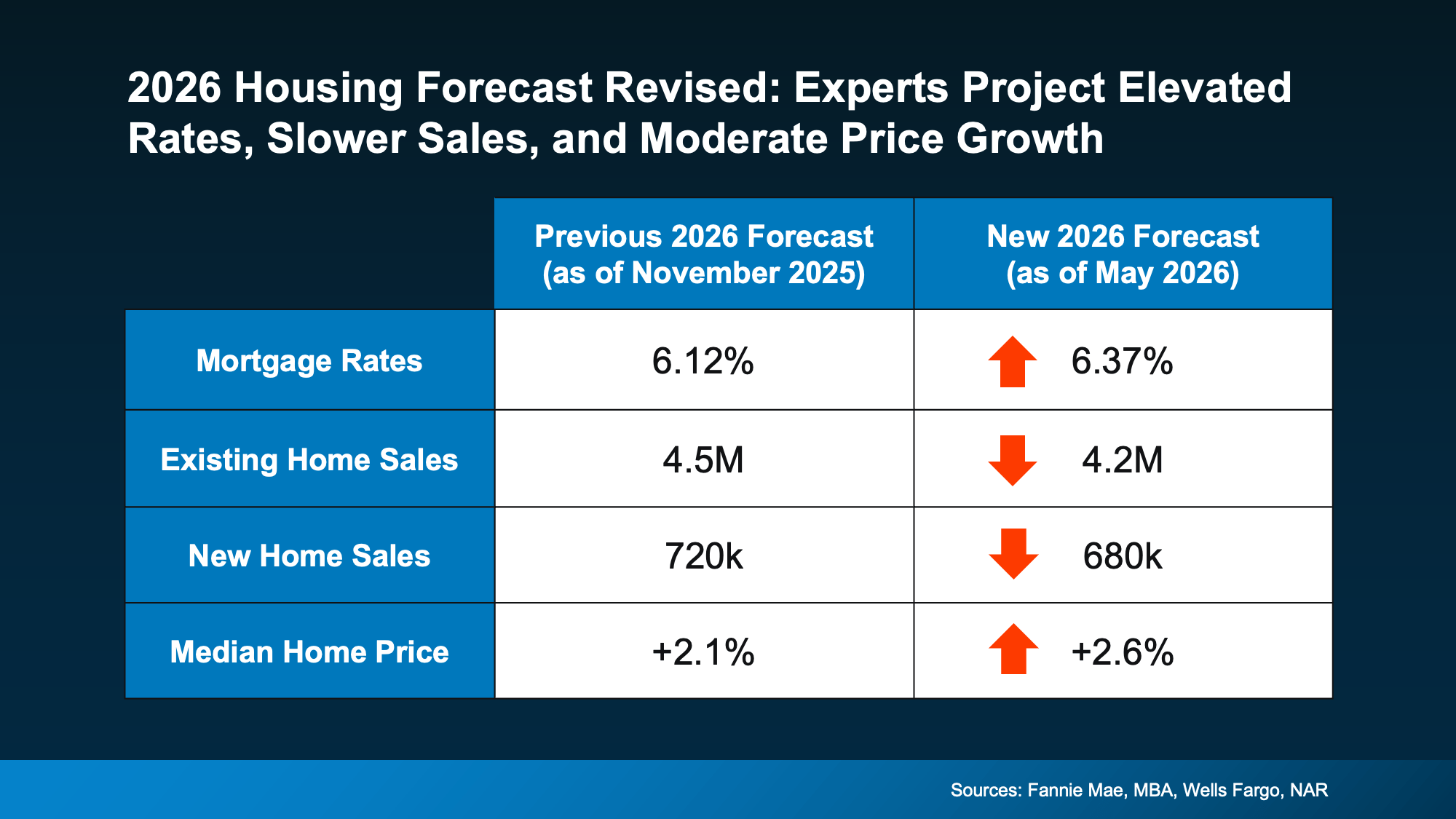
While everyone wants mortgage rates back in the upper 5s or low 6s we saw at the start of the year, experts don't think that's likely this year. Many industry organizations are now saying rates will stay in the mid-6s through 2026.
The good news? That's still lower than rates were a year ago. And for Atlanta homebuyers with solid financial profiles, there are still opportunities to build equity.
Of course, this is based on what we know today. If geopolitical tensions ease or inflation drops, things could shift. But if you're waiting for significantly lower rates, it may not pay off the way you expect—and you could face more competition if you delay.
EXISTING HOME SALES REVISED LOWER, BUT OPPORTUNITY REMAINS
Back in late 2025, experts expected 4.5 million homes would sell nationally this year. Now? That's dropped to 4.2 million.
Here's what that means: buyers are still hesitant because affordability remains challenging, especially for first-time buyers in our market.
Higher mortgage rates have made monthly payments harder to manage. That's slowed the pace compared to original expectations. But even with the revised forecast, we're still expected to see more home sales than last year.
The silver lining? Many experts believe that when geopolitical tensions resolve and rates begin to settle, a significant group of buyers will jump back in. As Lawrence Yun, Chief Economist at NAR, explains: "There is sizable pent-up demand that could be released into the market."
We've already seen glimmers of renewed hope lately. In recent months, pending home sales have been improving month-over-month despite higher rates.
So, if you're able to afford a home at today's rates here in Atlanta, it could still make sense to buy now. Waiting might mean facing more competition and fewer options when those other buyers re-enter the market.
NEW HOME SALES ALSO SLOWED IN OUR REGION
Builders were also expecting a stronger year. Earlier forecasts projected new home sales would top 720,000 nationally. Now, economists expect closer to 680,000.
Mortgage rates are a major reason why. But here's the upside for Atlanta buyers: builders may be even more motivated to sell. That means more builder incentives, negotiation opportunities, and pricing flexibility in our market.
If you're looking at new construction in Atlanta's growing suburbs and surrounding areas, this could be your moment. Builders have leverage concerns, and that means you might have more leverage to negotiate a better deal.
HOME PRICES ARE STILL EXPECTED TO RISE
This is one of the most important takeaways—and should give both buyers and sellers confidence.
Even though sales activity is slower, experts did not revise their home price forecasts downward. They still expect prices to rise nationally this year, and Atlanta's strong market fundamentals support continued appreciation.
Why? Because while buyer demand has softened, the number of homes for sale remains relatively limited. That imbalance continues to support prices, even in a slower market.
Atlanta's diverse neighborhoods, job market growth, and population influx provide strong support for sustained price growth. Whether you're buying or selling, steady price appreciation should be reassuring.
WHAT THIS MEANS FOR YOU
The Atlanta housing market hasn't rebounded as quickly as we hoped. But it hasn't stalled either.
Higher inflation and economic uncertainty caused economists to revise their forecasts. Importantly, when those conditions settle down, many experts believe the market will regain its momentum.
Don't see this revision as a sign of trouble. See it as a temporary reaction to overall economic conditions—and a snapshot of where we are right now, mid-year 2026.
At the Justin Landis Group, we're here to help you navigate this landscape. Whether you're a first-time buyer trying to time the market, a seller wondering about pricing strategy, or someone considering your options, we understand the Atlanta market and can guide you through it.
Let's connect and talk about what this means for your specific situation.