
What Atlanta Buyers Should Know About Radon Gas
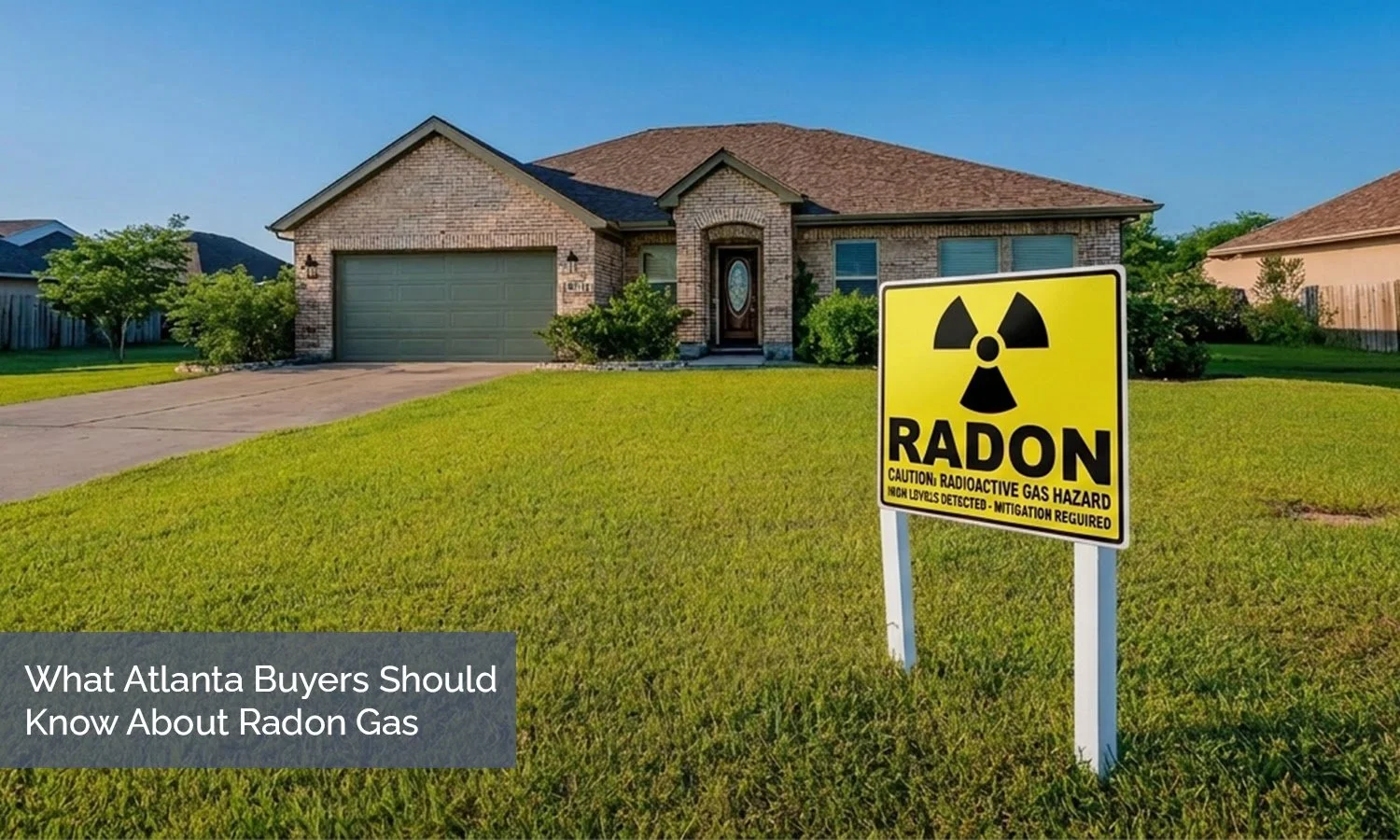
Atlanta home purchases include a long list of competing factors to balance - financing, inspections, negotiations, timelines. Radon almost never makes that list, and a big part of that comes from the assumption that the South's warm climate and above-grade construction make it a non-issue. For most buyers, it's fair enough to believe - but it's also an assumption that can get expensive, or in a worst case, quite harmful to your health.
Georgia's geology is worth a bit of attention. A large portion of metro Atlanta sits on granite-rich soil, and granite is a natural source of radon. The issue is that radon has no smell, no color, and nothing about it tells you it's there - you need equipment to detect it at all. A handful of metro-area counties already have average radon levels that exceed the EPA's action threshold - and that's before a single home is even tested. A house in perfect condition can still have elevated concentrations in its lower levels.
The stakes legitimately do justify more attention. Radon is the second leading cause of lung cancer in the United States, and Georgia alone sees roughly 800 deaths from it every year. For something that most buyers in the state never even think to ask about, 800 deaths a year is a pretty sobering number.
Due diligence is the right time for this - not after you move in, when that bargaining power is long gone. Mitigation systems are much easier to get the seller to help cover when they're negotiated into the deal from the start, and the opportunity disappears once you sign. A seller who gets an elevated test result back will be far more willing to help cover the cost than they will be six months later, when the sale is closed, and the problem is yours. From what I've seen, it's one of the most ignored points in the whole home-buying process.
Let's talk about what every Atlanta buyer needs to know about radon gas.
Atlanta Homes Have a Real Radon Problem
Georgia has some of the most granite-rich soil in the entire Southeast, and the geology matters a great deal to homeowners. Granite contains uranium, and as that uranium slowly decays over time, it releases radon gas into the surrounding soil. From there, the gas makes its way up through the ground and right into the foundation of whatever sits above it.
Plenty of buyers think a warm Southern climate means radon isn't something worth worrying about. It's an understandable conclusion. Radon levels depend far more on what's underneath the ground than on what the weather is like outside.
The EPA breaks the country up into radon zones, and a large portion of Georgia lands in Zone 2, which is a moderate rating, while much of the northern part of the state falls into Zone 1, the highest rating. Either way, the soil and geology in this region are more than capable of pushing radon into a range that can do damage to your health over time.
The gas itself enters a home through cracks in the foundation, gaps around the pipes and even through porous concrete. Homes with basements or slab foundations that sit near granite-heavy soil draw in more of it. A home's structure tends to collect whatever rises up from the ground beneath it.
It's worth a radon test when you buy a home in this state. Most sellers aren't going to bring it up on their own, and the results can change how you feel about a deal - or at a minimum, give you something worth raising in negotiations. It's not hard to check, and it's not something that you'll ever wish you had skipped.
Test the Air Before You Move In
A beautiful home can have a radon problem just as much as a run-down one. Fresh paint, a spotless basement, a newly renovated kitchen - none of it tells you anything about what's floating around in the air.
Radon testing is simple and affordable. Short-term test kits run anywhere from $15 to $30 and most hardware stores carry them. Place one in the home for 48 to 72 hours, then mail it to a lab and wait for the results to come back. For a fuller picture of radon levels over time, longer-term kits are also an option - these monitor air quality over the course of a few months.
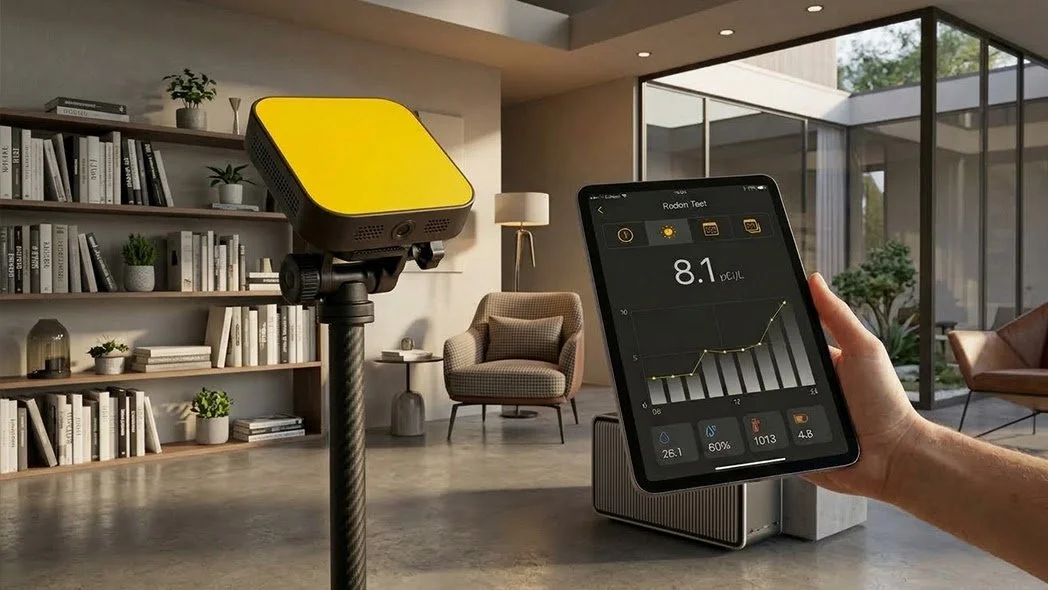
Basements and lower floors are where radon problems are the worst - it seeps in from the ground and just settles in spaces where the air doesn't move much. When you have a finished basement or any lower-level living area, that's where you should test first.
For buyers especially, this fits right into the home inspection window that you've already got scheduled - and with everything else on your plate during a transaction, it's one of the least disruptive things to add. No extra trips, no delays, just a quick ask that gets you an answer to a question that actually matters. Radon has no smell and no color, and without a test, there's no way to know what the levels are inside a home that you're about to move your family into. An answer before closing means that you won't have to worry about it once you're in.
How to Read Your Radon Test Results
Once your radon test results come back, the number that you want to look at is the EPA's action level of 4 picocuries per liter, or 4 pCi/L. At or above that level, the EPA recommends that you do something about it and bring that concentration down. Not a legal limit or some hard regulatory cutoff, it's more of a sensible guideline built to balance what's realistically possible with what's actually protective for the average home.
A reading below 4 pCi/L is usually considered to be in a safe and acceptable range, though no radon level is entirely without risk.
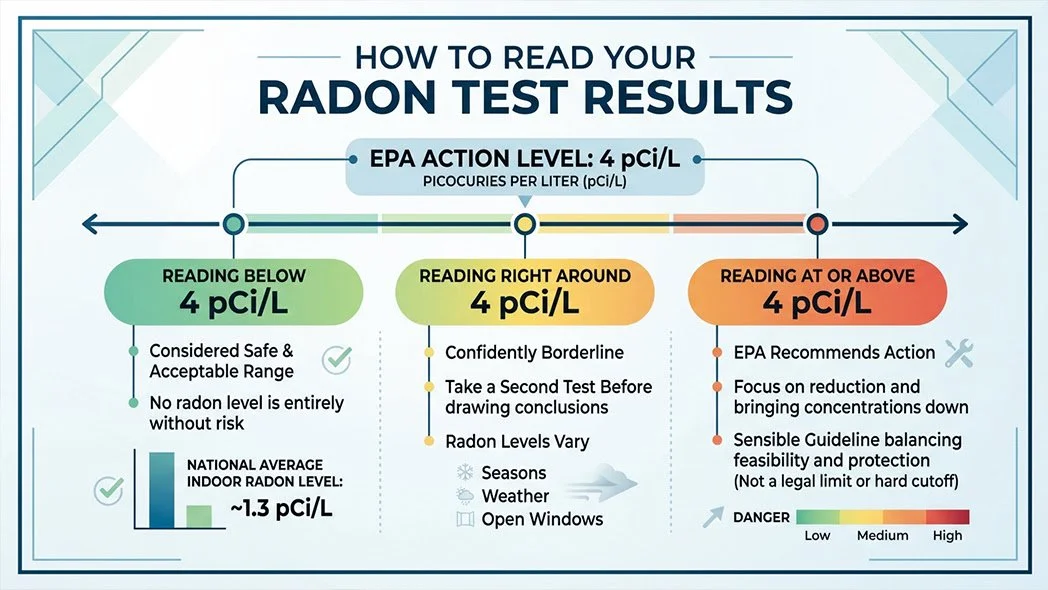
If your number comes in right around that 4 pCi/L mark, a second test is well worth doing before drawing any conclusions. Radon levels can vary quite a bit - the season, the weather and even how recently your windows were open can all have an effect. One borderline reading from a single test just doesn't tell you enough to go on.
A reading well above 4 pCi/L is understandably going to raise some concern, and a little context alongside it can help. Every person is exposed to some level of radon on a day-to-day basis, just from the natural environment around them. The national average indoor radon level across the U.S. sits at around 1.3 pCi/L, which gives your result a comparison to work with. The number on your report is information - it's enough to move forward with confidence.
The Health Toll That Radon Takes
The EPA ties radon exposure to roughly 21,000 lung cancer deaths in the United States every year. That number deserves so much more attention than it gets.
For anyone who smokes, the concern shoots up quite a bit - dramatically, in fact.
For families with young kids especially, this information can be quite a bit to take in all at once. A home is supposed to be a safe place for the family that you love most - and the news that a colorless, odorless gas can work away at your family's health bit by bit over years and years does put a different weight on that whole choice.

Radon's biggest problem is that it gives you no warning signs at all - no smell, no physical reaction, nothing to flag that something's off. That invisible exposure is not hard to push aside when your attention is already pulled in a dozen directions - inspection reports, mortgage rates, closing costs and a hundred other decisions that are all competing for your focus at once. A visible hazard gets dealt with pretty fast because it's hard to look past it. Radon doesn't work that way. The damage builds over the years without any sign it's happening - there's never a point where it forces its way onto your priority list.
The fact that radon is so dangerous and yet gets so little attention from most buyers is part of why it deserves its own place in your due diligence process - not as an afterthought, but as a genuine part of the conversation, right alongside everything else on your checklist.
Radon Can Be Fixed Before You Close
Radon on your inspection report is never welcome news. But it's actually one of the more fixable problems a house can have - and the fix is proven, reliable and pretty easy to get done.
The most common fix is something called a sub-slab depressurization system. A contractor comes in, drills a small hole through your foundation slab and runs a pipe up and out of the house. From there, a fan continuously pulls radon from beneath the slab and vents it safely outside - well before it gets a chance to build up indoors. The whole installation is pretty quick, and most homeowners are back to normal the same day.
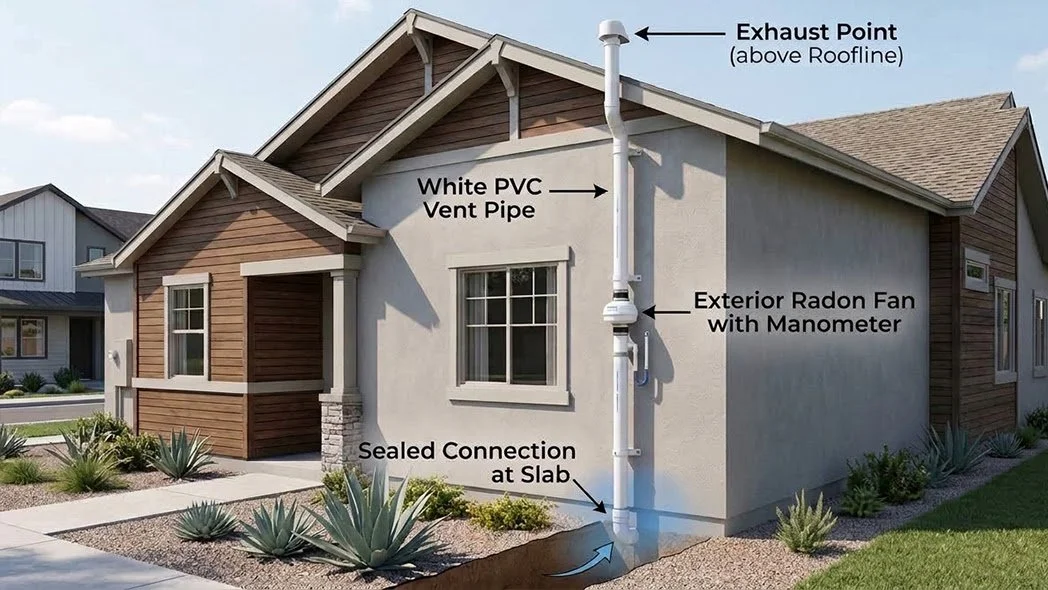
These systems work well - radon levels can drop by as much as 99% in most cases. For homes in the Atlanta area, installation usually runs between $800 and $2,500, and the final number can depend on the home's layout and foundation type - it's an expense, no question about it. When you're buying a home, it's a pretty fair ask.
A high radon reading is not a reason for you to walk away from a home that you love. It's a well-established repair, and it comes with a pretty predictable price range. Buyers get nervous about costs that pop up late in the process - it's a very fair concern to have. Radon mitigation is one of the few repairs where you can usually get a firm number on what it'll cost before you ever close. Having that price before the sale is final puts you in a much better position than finding out months later - after you've already moved in, unpacked and made it home.
Who Pays for the Radon Fix
That known cost is a concrete number - and one to have on hand. Put it on the table.
The best time to bring up radon is during your inspection window. Georgia real estate contracts have an inspection contingency period built in - it's the phase where buyers have the most room to push back without putting the deal in jeopardy. Once that window closes, your negotiating power drops considerably. That conversation gets much harder to have.
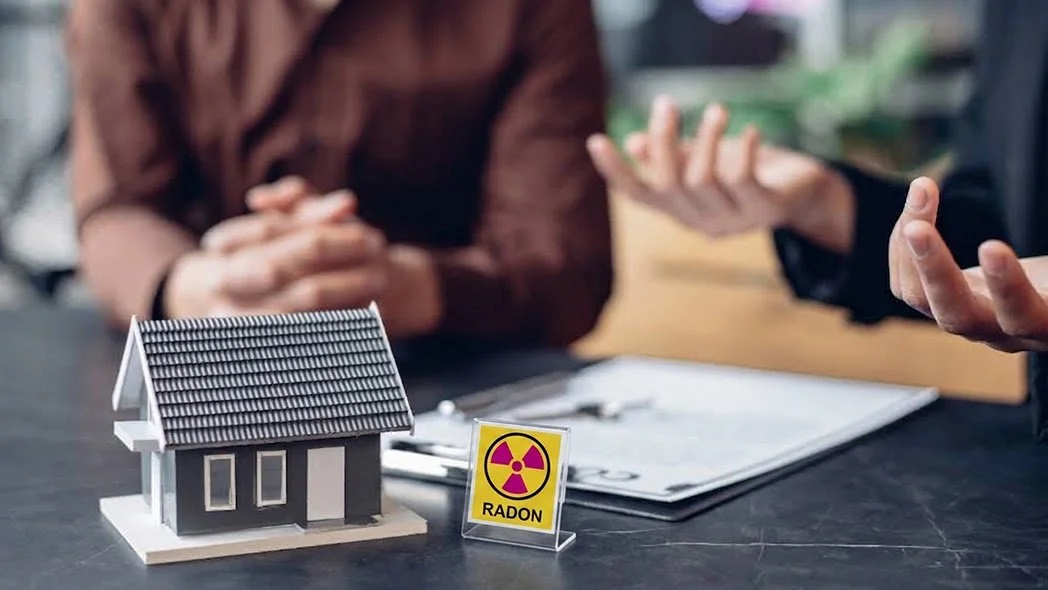
At this stage, there are a few fair options to raise with the seller. A mitigation system installed before closing, a shared cost agreement or a straight reduction to the sale price to cover the expense - all three are fair requests, and none of them are out of line. Most sellers go into the inspection phase already prepared for some give-and-take, and this negotiation is a pretty normal part of buying a home. There's no need to feel awkward about any of it.
A documented test result makes this much easier to work with. With a number, a printed report and an estimated remediation cost already in hand, the conversation with the seller changes from your word against theirs to a fact-based one. That alone removes the personal friction from the negotiation. Radon mitigation is also a common fix with a cost range that most buyers can plan around - and the predictability of it puts you in a stronger position at the table.
Your agent can word the request in a way that comes across as fair and cooperative, instead of combative.
Moving to Atlanta?
The hard part is already behind you. At this point, you know what radon is, where it comes from and what a positive test actually means for a deal. That preparation goes a long way at the negotiating table.
Radon is not a reason to walk away from a home that you love. It's just one more issue to sort out and a very manageable one at that. In my experience, the buyers who feel best about this whole process are usually the ones who asked the right questions early on - and the fact that you're already doing that puts you in a great position.
Atlanta's real estate market moves fast, and a great team behind you can change the whole experience. At the Justin Landis Group, we know this city well - the market, the neighborhoods and those little details that never quite make it onto a listing page. Whether it's the fun parts of a home search or the ones that take a little more patience, we're with you at every step along the way. Whether it's a quiet street in the suburbs or a place with a little more city energy - whatever feels right to you, we'll help you get there. And with everything that you've already learned about radon, you'll head into that process well prepared.
Whenever you're ready to find your next home, we at the Justin Landis Group would love to work with you - get in touch with us.