
Charlottesville vs Albemarle County Property Taxes 2026
Most buyers walk in with the assumption that the city and its surrounding county share one unified system - same rate, same assessor, same bill structure. In this case, that assumption is wrong. That mistake can cost you hundreds of dollars a year in budget miscalculations without you even realizing it.
Charlottesville and Albemarle County are two separate jurisdictions, and each one has its own elected body to set the tax rates and its own process for property assessments. A house on one side of the city line plays by a very different set of laws than a house a mile away on the other side. If the math on those numbers is off before a contract gets signed, you'll go back to recalculate the mortgage estimates, insurance escrow and monthly cash flow after everything is already in motion - it's not a great place to be when you're already this far into a big financial move.
The two jurisdictions raised their assessments for 2026, which means even a flat tax rate will produce a bigger bill than the year before. First-time buyers and longtime owners are feeling that pressure. Assessment values tend to change more than buyers expect, and the difference between what they expect to pay and what they owe can be quite a bit more than they planned for.
Once you have a sense of the adopted rates, how assessed values feed into that final number and what services your tax dollars fund, then you'll have a more accurate picture of what housing actually costs - and you want that in hand before you sign on to anything!
Let's talk about these 2026 property tax differences so you can plan ahead!
The City and County Have Separate Tax Rates
Virginia has a government setup that residents who move from other states have never run into before. Across most of the country, cities sit inside counties and share their local government with them - it's just how local government is structured everywhere else. Virginia does it a bit differently, and it matters quite a bit if you're looking to move there.
Charlottesville carries a designation that Virginia calls an "independent city," and it's a distinction that means quite a bit (the city operates as its own standalone government, kept separate from Albemarle County), with no shared school board, no shared tax rate and no shared governing body of any kind between them.
Property taxes are where this split between the city and county starts to matter. Charlottesville sets its own rate every year, and Albemarle County does the same independently. Neither rate has any bearing on the other, and over time, the two can go in very different directions.
A home just 1 mile away from another can fall under a very different tax jurisdiction, and the street that you live on (and which side of it) decides who actually sends you that bill.
Your property address will tell you which jurisdiction covers your home - either the City of Charlottesville or Albemarle County. If a sale is already underway, your agent or settlement attorney can confirm this well before closing. Getting that answer early can shape a few of the decisions along the way.
The next section covers the tax rates for each locality in 2026. Most of the numbers won't make much sense without the city and county split that we just covered, so keep that context in mind as you go.
The 2026 Property Tax Rates and Assessed Value
Property tax rates are usually one of the first numbers buyers want to know - which makes plenty of sense. The rate in Charlottesville has historically landed around $0.95 per $100 of assessed value, and Albemarle County comes in a touch lower at around $0.854 per $100. A fraction of a percent can look small on paper. But put those numbers up against home values in either area, and the gap starts to add up pretty fast.
To put some numbers behind it, take a home assessed at $400,000. At the city's rate of $0.95, the annual property tax bill lands at roughly $3,800. That same home out in the county, at $0.854, brings that number down to around $3,416. The gap works out to nearly $400 a year - it's only from the rate difference, nothing else.

These figures could still change for 2026. Every year, local governments go back through their annual budget process and revisit their rates, so the numbers above are based on recent history - not a confirmed figure. Before you make any final decisions, it's worth a direct call to Charlottesville's city government and to Albemarle County to find out if any adjustments are on the table.
Plenty of buyers only look at the tax rate, and the assessed value can get forgotten. The rate matters. But so does the number it gets applied to, which is your home's assessed value. That number can move up or down from year to year. A lower rate won't necessarily mean a lower bill if the assessed value on that property is already high. These two numbers work together and affect what you finally owe, and both of them deserve your attention.
Why Your Tax Bill Goes Up Each Year
Property tax rates get most of the attention and understandably so - they're directly connected to what you owe. But your home's assessed value matters just as much. Even if your tax rate stays flat, a higher assessed value will still push your annual bill up.
Home values in Charlottesville and Albemarle County have gone up quite a bit over the last few years. When the property tax bill arrives, plenty of homeowners find themselves with a number that's noticeably higher than they paid the year before - it's a frustrating place to land. That's also the case when the tax rate itself didn't change at all.

A reassessment is how your local government refreshes the official value of your home on paper. Localities in Virginia are required to do this at least once every four years, and plenty of jurisdictions actually do it every year. Whatever number comes out of that process gets multiplied by the local tax rate - it's what ends up on your tax bill.
Longtime homeowners feel this especially hard - and even more so for those on a fixed income. After twenty or thirty years in the same home, a rising assessment can legitimately put your ability to stay there in jeopardy - even when nothing about your finances has changed. It's a pretty frustrating side effect of a strong real estate market, and local officials hear about it quite a bit.
Your options aren't exhausted just yet, though. If your assessment feels too high, you can file a formal appeal with your local assessor's office. A strong case needs some concrete evidence behind it, though - and recent sales of comparable homes in your neighborhood will usually make the strongest argument.
The Spring Budget Cycle and the Rate Vote
Charlottesville and Albemarle County wrap up their property tax rates in the spring, and the whole process goes roughly the same way year after year. Local governments put together their proposed budgets, hold public hearings and then vote to settle on a final rate.

The public hearing (the middle step in the process) is the one most residents skip right over, which is a shame. It's one of the few times that you can get in front of local officials and have a voice in what comes next. Attendance is open to everyone, and anyone who can't make it in person will find that most municipalities stream the hearing live and leave recordings up afterward. When a rate change is on the table, that's the time to show up.
Local news coverage in January and February is also worth a look. Reporters pick up on budget proposals pretty early in the year, and the early coverage gives you a sense of where rates are going well before anything is made official. That early read gives you more room to plan and time to push back or ask questions if something doesn't quite add up.
With that said, don't make any big financial decisions based on a proposed rate. A number that's still floating around in an early budget draft can change (sometimes by quite a bit) before the final vote even happens. Any plans that you've built around a figure that's still up for debate could need a full overhaul at the worst possible time - it's a headache that you don't need. The rate that will actually show up on your tax bill is the adopted rate - it's the only number worth your attention.
Once that final number gets published, you'll have a baseline to plan around with confidence.
Where Your Tax Money Goes
The tax rate is usually the first number that jumps out, and it's tempting to let the comparison start and end right there. What that number actually pays for deserves just as close a look.
Charlottesville's tax revenue funds city schools, trash pickup, road maintenance, emergency services and public utilities - and the city manages these in-house, which gives residents a pretty consolidated package. Albemarle County covers most of the same ground, though the structure works a bit differently out there. A handful of services run through separate channels, and where in the county you land can also affect what you pay.
A lower tax rate in the county doesn't always translate to a lower cost of living out there. That gap matters far more than it gets credit for.
Schools deserve their own conversation here. Charlottesville City Schools and Albemarle County Schools are two separate systems - with different funding levels, programs and long-standing reputations. For families with kids, the school district is usually the single biggest factor in where they buy. Both districts get strong marks, and neither one is a bad choice by any stretch - each has its own strengths, and what your household cares most about will go a long way toward shaping which one is the right fit. Don't treat school research as an afterthought - it deserves time and attention.
Outside of schools, some facts only become apparent once you're settled into a new place. How close are the nearest fire and rescue services to your address? Is road maintenance kept up in the neighborhoods that you're weighing? Does the area run on public water and sewer, or would you be working with a private well and a septic system? These questions take a basic tax rate comparison and turn it into a full picture of what it costs to live somewhere.
Life Outside the City Is Not That Simple
A home just past the Charlottesville city line, in Albemarle County, can mean a noticeably lower property tax bill - and for buyers, that ends up being a pretty big difference over time. That said, it's not the full picture.
The school district that you fall into changes when you cross that line, and for families, that's a big deal. Charlottesville City Schools and Albemarle County Schools are two very different systems - different reputations, different resources and different areas of focus. If schools are at the top of your list, that difference between the two could matter quite a bit. It's very much a personal call that only your household can make.

Road maintenance and utility services can also be pretty different depending on where you land in the county. Plenty of rural areas run on private roads and response times for basic services can stretch much longer than they do in the city. A few hundred dollars in annual tax savings sounds pretty tempting - right up until those same dollars go toward service gaps that you weren't accounting for.
Before any final decisions get made, it's worth thinking through a few questions. Commute time adds up pretty fast over the course of a week. A longer drive can be a fair trade-off, or it can be a deal-breaker.
None of these questions have a universal answer, and I'd be careful about letting one number (even a pretty tempting one) make the call. The tax rate is real, and it deserves your attention. It's just one part of a much bigger picture that's very personal.
How to Find the Official Adopted Rates
For the most up-to-date tax rates in either area, the best place to look is directly on their official websites - and I'd always recommend that you go right to the source on something like this. Charlottesville publishes its adopted rates at charlottesville.gov, and Albemarle County does the same at albemarle.org. On each site, a section labeled either "Finance" or "Commissioner of the Revenue" is where the tax rate information tends to live.
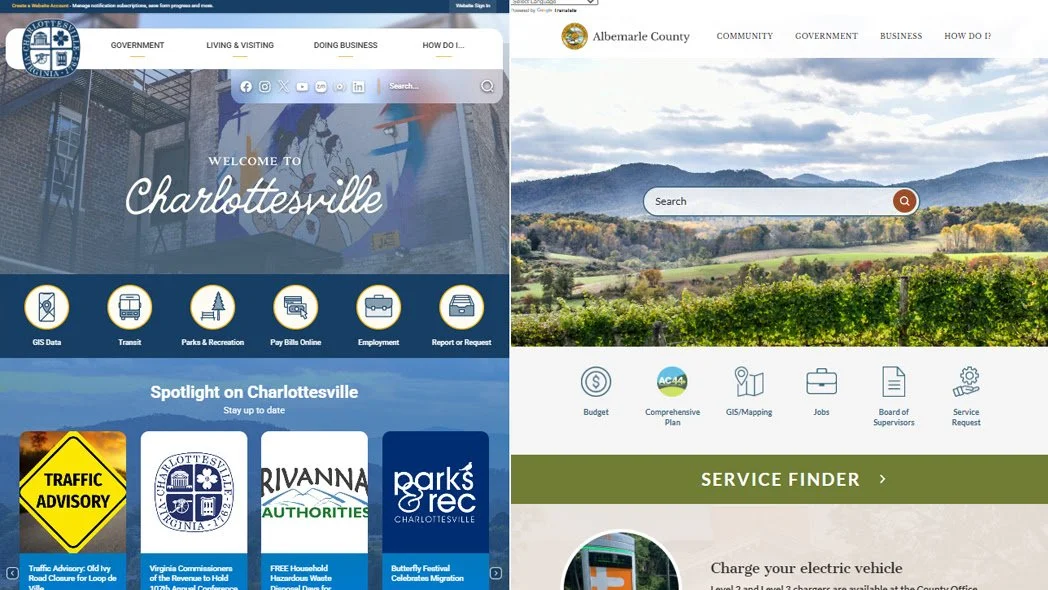
The information ages fast, since tax rates get voted on and adopted fresh every year. A blog post from last spring, or something a neighbor mentioned around the time of their closing, could be a full budget cycle behind what's actually on the books. An official source cuts through that (it will tell you the number that's currently in effect) - not an estimate, not something half-remembered and not a figure that expired twelve months ago.
These pages are worth a bookmark. Next year, when budget season comes around, you'll already know right where to go - no need to search for it all over again.
If something doesn't look right to you, just call the office. The staff at the Charlottesville Finance Department and the Albemarle County Commissioner of the Revenue answer these questions all the time - they can confirm a rate in seconds and point you right to the exact line item you need. A two-minute phone call will get you a far more reliable answer than anything that you would find on a third-party website or an old forum post.
Property tax rates have an effect on your monthly payment, your annual budget and your cost of living in whichever area you're thinking about - and those rates do change from year to year, so it's worth a few extra minutes to verify the numbers directly from an official source instead of a figure that you found somewhere else.
Moving to Charlottesville?
Two separate governments, two separate rate-setting processes, assessed values that continue to rise and genuine differences in what each tax dollar actually covers - that's quite a bit to track all at once. With all these pieces in motion and none of them directly connected to the other, it makes sense that the whole picture can be a little hard to follow. Hopefully a walkthrough of how each part connects has made it all feel a bit more manageable.
The single best habit to walk away with is an easy one - always go back to the official source and verify the adopted rate before making any financial decisions. Proposed numbers change, assessments get updated, and what somebody told you last year might not match what's in effect. That one extra step only takes a couple of minutes, and in my experience, the ones who skip it are usually the ones who pay for it later.

A rate sheet is only half the picture. The full cost of living in any given area (schools, local services, your day-to-day commute, utilities and the little details that make up your day) carries just as much weight as any single line on a document. Add all that up, and a comparison between two communities turns into something far more personal. The cheaper number on paper doesn't always come out on top once you account for everything that shapes how you live.
These decisions carry weight, and the right support through the process can go a long way. The Justin Landis Group knows this area well, and we're ready to use that knowledge so you can get through it. Reach out when you're ready - let's find the right home together.